
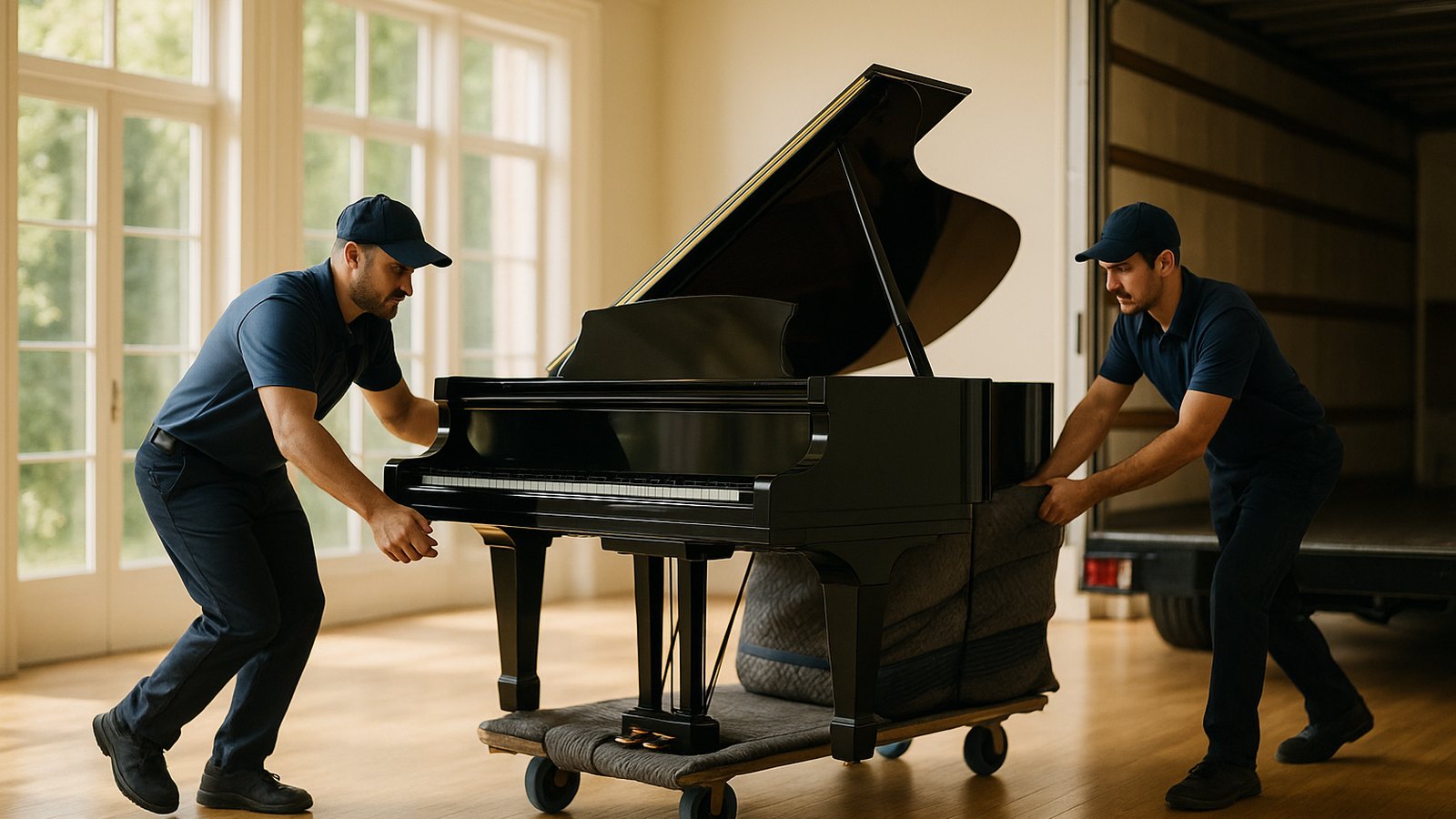
People picture six strong backs walking a grand up the stairs in one piece, and that picture is exactly how a $20,000 instrument gets cracked. A grand piano is never carried upright. It is tipped onto its side, set on a skid board, partly taken apart, and walked up controlled and balanced by a crew that does only this. Paul Marchetti grew up on Mount Auburn Street in Watertown, worked as a piano technician before he ran a truck, and his uncle moved grands for the music schools around Cambridge and Boston, so this is family trade as much as a service. Here is what actually happens when a grand has to go up a flight of Boston stairs, and why the brownstones and triple-deckers of this city made piano moving its own craft.
A Grand Does Not Go Up on Its Legs
The whole technique rests on one fact: a grand is strongest on its straight side and weakest standing on its three slender legs. Carrying it upright puts the entire weight and every jolt through those legs and the lyre that holds the pedals, the most fragile castings on the instrument. So the crew never does it. The piano comes apart and rides on a board instead, which spreads the load and keeps the delicate parts out of harm way.
Walk through how a grand is prepared and moved:
- The lid is closed and locked, the music desk removed, and the keyboard cover secured so nothing swings during the carry.
- The piano is tipped onto its long straight side and lowered onto a padded skid board, the moment that needs the most hands and the steadiest control.
- The legs come off one at a time as the weight transfers to the board, then the lyre and pedals are detached and wrapped separately.
- The whole instrument is blanketed and strapped to the board so it is one solid, padded unit with no loose surface.
- The crew walks it up the stairs on the board, one mover guiding from below and bearing the load, others above controlling the descent of weight, all moving on a count.
- At the top it is set down, stood back up, and rebuilt — legs, lyre, and pedals back on, leveled and checked before it goes to its spot.
What Boston Stairs Throw at a Grand
This city housing stock is the reason piano moving here is a specialty and not an afterthought. The staircases were built for people, not for a 700-pound instrument on a board:
- Beacon Hill and Back Bay brownstones have narrow, winding switchback runs with a tight landing turn, the hardest geometry for a long board to pivot through.
- Somerville and Cambridge triple-deckers stack three steep walk-up flights with no elevator, so an upper-floor grand is a long, deliberate climb.
- Newton, Brookline, and Belmont Victorians often hide a family grand at the top of a back staircase that was never meant to see one.
- The North End adds tight cobblestone streets where even getting the truck and the board to the door is half the work.

Weights, and What the Crew Reads Before the Climb
How a grand goes up depends almost entirely on its weight and the staircase it faces. The crew sizes the job before a single strap goes on:
| Instrument | Typical Weight | Usual Crew | What Decides the Climb |
|---|---|---|---|
| Baby grand | 500–650 lbs | 2–3 movers | Landing turns and stair width |
| Grand | 650–900 lbs | 3 movers | Number of flights, switchbacks |
| Concert grand | up to 1,400 lbs | 3–4 movers | Whether the stairs can take it at all |
The numbers explain why we measure first. A nine-foot concert grand at well over half a ton simply will not negotiate some switchback brownstone stairwells safely at any crew size, and that is the point where the conversation turns to a crane.
When the Stairs Win and a Crane Goes Up
Sometimes there is no stair path the instrument can take. A switchback that is too tight to pivot a long board, a fourth-floor Back Bay unit with a stairwell that pinches at every landing, a building where the only opening is a window. In those cases the grand goes up the outside of the building on a crane, lifted on the board through a window or over a balcony, then brought in and rebuilt. It is dramatic to watch and entirely routine for us, and it runs $650 to $1,800 depending on the reach and the floor. We tell you at the quote whether the stairs will work or a crane is the safer call, never on the day.
My uncle moved grands for the conservatories around Cambridge, and the first thing he taught me was that the stairs decide the plan, not the other way around. We read the staircase before we read the piano. A switchback landing in a Beacon Hill brownstone will tell you in thirty seconds whether you are walking it up or calling a crane, and guessing wrong is how instruments and people get hurt. — Paul Marchetti, owner
Mt Auburn Piano Movers is a licensed and insured Massachusetts mover with a Massachusetts DPU carrier license, USDOT and MC authority, and $1M cargo coverage, running its own piano-only crews out of Watertown. We move pianos and a short list of heavy specialty pieces, never general household goods, and we never subcontract. The full handling method lives on the piano moving page, and the service areas page shows whether your street is on our list.
Frequently Asked Questions
How do you move a grand piano up stairs?
The grand is tipped onto its straight side and set on a padded skid board, then the legs, lyre, and pedals come off. The crew walks it up the stairs flat on the board, controlled on a count, and rebuilds it at the top. It is never carried upright on its legs.
How much does a grand piano weigh?
A baby grand runs roughly 500 to 650 pounds, a full grand 650 to 900, and a concert grand up to about 1,400. The weight, together with the staircase, decides how many movers come and whether the stairs are usable at all.
What if the staircase is too narrow or too tight?
If a switchback or a tight landing will not let the board pivot through, or an upper-floor unit has no stair path that fits the instrument, the piano goes up on a crane through a window or over a balcony. We flag that at the quote, not on move day.
Why take the legs off a grand to move it?
The legs and the lyre are slender castings that carry the pedals and hold up the instrument; they are the parts most likely to crack under a jolt. Removing them and moving the body flat on a board keeps the load off the fragile parts and out of the soundboard path.
Do you move grands in Beacon Hill and Back Bay walk-ups?
Yes, constantly. The switchback brownstone staircases and no-elevator walk-ups in Beacon Hill, Back Bay, Somerville, and Cambridge are exactly the buildings we specialize in, by stairs where the geometry allows and by crane where it does not.
Have a Grand at the Top of Boston Stairs?
Give us the piano type, the building, the floor, and a look at the staircase, and you will get a straight answer on whether it climbs the stairs or rides a crane, with a flat figure on paper either way.